IND: +91 9629929970
 USA: +1 (415) 718-2654
Things to Do in Jaipur: 20 Best Experiences in the Pink City
Quick Answer
Jaipur, the Pink City, was founded in 1727 by Maharaja Sawai Jai Singh II as India's first planned city, and added to the UNESCO World Heritage List in 2019. The essential experiences are Amber Fort (India's finest Rajput hill fort, ₹100/₹500), Hawa Mahal (953-windowed "Palace of Winds", ₹50/₹200), City Palace (part-royal residence, part-museum, ₹200/₹700), Jantar Mantar (UNESCO-listed astronomical observatory, ₹50/₹200), a hot air balloon flight over the forts at sunrise, the Jaipur Literature Festival (world's largest free literary festival, January), and shopping for gemstones, blue pottery, and block-printed textiles in the old city bazaars. Best time to visit: October to March. |
|---|
Jaipur Attractions — Entry Fees & Timings
Attraction | Indian Entry | Foreign Entry | Timings |
|---|---|---|---|
Amber Fort | ₹100 | ₹500 | 8 AM – 5:30 PM |
Hawa Mahal | ₹50 | ₹200 | 9 AM – 5 PM |
City Palace | ₹200 | ₹700 | 9:30 AM – 5 PM |
Jantar Mantar | ₹50 | ₹200 | 9 AM – 4:30 PM |
Nahargarh Fort | ₹50 | ₹200 | 10 AM – 5:30 PM |
Jaigarh Fort | ₹35 | ₹85 | 9 AM – 4:30 PM |
Albert Hall Museum | ₹40 | ₹300 | 10 AM – 5 PM (closed Friday) |
Jal Mahal | Free (exterior only) | Free | Viewable from road |
Galtaji Temple (Monkey Temple) | Free | Free | Sunrise to sunset |
Chokhi Dhani (cultural village) | ₹850 | ₹850 | 5 PM – 11 PM |
The Pink City: History and UNESCO Status
Jaipur was founded on 18 November 1727 by Maharaja Sawai Jai Singh II — astronomer, mathematician, and ruler of the Kachhwaha Rajput clan. It was the first city in India to be planned according to the principles of Vastu Shastra (ancient Hindu architectural science), designed with a grid layout of nine rectangular blocks representing the nine divisions of the universe. The city's characteristic pink colour dates to 1876, when Maharaja Ram Singh II ordered all buildings painted terracotta pink to welcome Prince Albert of Wales — and the tradition has been maintained by city ordinance ever since.
In 2019, Jaipur was inscribed on the UNESCO World Heritage List as a "planned Hindu city" — recognised for its "exceptional example of town planning and exchange of human values" that "represents an exceptional achievement in town planning."
Jaipur is also the world's largest centre for gemstone cutting and trading — approximately 25% of the world's coloured gemstones pass through the city's gem polishing and trading houses.
Amber Fort — India's Finest Rajput Hill Fort
Amber Fort (Amer Fort) is the most impressive fort in Rajasthan and the defining experience of a Jaipur visit — a massive complex of palaces, halls, gardens, and temples built into the Aravalli Hills 11 km north of the city, overlooking the Maota Lake below. Construction began in 1592 under Raja Man Singh I and continued for 150 years across successive rulers of the Kachhwaha dynasty.
The fort's signature space is the Sheesh Mahal (Hall of Mirrors) — a private royal chamber where thousands of small convex mirrors are set into the ceiling and walls, designed so that a single candle flame would illuminate the entire room. The effect, even under electric light today, is extraordinary. The Diwan-i-Aam (Hall of Public Audience) and Diwan-i-Khas (Hall of Private Audience) are the finest examples of Mughal-Rajput architectural fusion in Rajasthan.
- Entry: ₹100 (Indians), ₹500 (foreigners); audio guide ₹150 (strongly recommended — the fort is large and context-free without it)
- Timings: 8 AM – 5:30 PM; Light & Sound Show: 7 PM (Hindi) and 8 PM (English) — ₹295
- Getting there: 11 km from Jaipur city centre; auto-rickshaw or Ola ₹150–₹250 one way
- Elephant rides: Available at the main gate (₹900–₹1,100 for two people); controversial for animal welfare reasons — the on-foot approach up the cobbled ramp takes 15 minutes and is equally atmospheric
- Tip: Visit at opening time (8 AM) — the fort is far less crowded, the light on the palace walls is best, and the Maota Lake reflects the fort before tour groups arrive
Hawa Mahal — The Palace of Winds
Hawa Mahal (Palace of Winds) is Jaipur's most photographed landmark — a five-storey sandstone façade of 953 semi-octagonal windows with carved stone lattice screens (jharokhas), built in 1799 by Maharaja Sawai Pratap Singh. The building was designed for the women of the royal household to observe street festivals and processions without being seen — a function of the purdah system of female seclusion. The latticework creates a natural ventilation system that keeps the interior cool even in Jaipur's intense summer heat.
The building is essentially a façade — most floors are a single room deep — but the interior offers excellent views of the old city from the upper levels, and the exterior façade is among the most distinctive pieces of architecture in India.
- Entry: ₹50 (Indians), ₹200 (foreigners)
- Timings: 9 AM – 5 PM daily
- Best photography: From the street (Hawa Mahal Road) in the morning before 10 AM when the light hits the sandstone façade directly. There is a rooftop café on the building opposite that gives the classic elevated shot.
- Tip: Combine with the old city bazaars (Johari Bazaar is 100 metres away) and City Palace (1.5 km walk through the old city)
City Palace — Living Royal Heritage
City Palace (Chandra Mahal) was begun by Maharaja Sawai Jai Singh II in 1729 — the same year the city was founded — and continued to be expanded by successive rulers. Uniquely, the Jaipur royal family (the Kachwaha Rajputs) still reside in the uppermost floors of the Chandra Mahal, making it one of the few royal palaces in India with an active royal occupant. Visitors can access the museum sections, courtyards, and the Diwan-i-Khas (Hall of Private Audience), which contains two enormous silver urns — each 1.6 metres tall and weighing 340 kg, the largest silver objects in the world — used by Maharaja Sawai Madho Singh II to carry Ganges water to England for the 1902 coronation of Edward VII.
- Entry: ₹200 (Indians), ₹700 (foreigners); premium royal grand tour ₹2,500 (includes parts not in regular access)
- Timings: 9:30 AM – 5 PM daily
- Tip: The Peacock Gate (Mubarak Mahal courtyard) — with its four ornate gates representing the four seasons — is among the finest photographic compositions in Rajasthan and is included in the standard ticket
Jantar Mantar — UNESCO Astronomical Marvel
Jantar Mantar (Sanskrit: "instrument for measuring") is an open-air astronomical observatory built by Maharaja Sawai Jai Singh II between 1724 and 1727 — one of five he built across northern India, and by far the largest and best-preserved. It contains 19 astronomical instruments, each designed to measure time, predict eclipses, and track celestial bodies. The most impressive is the Samrat Yantra — a 27-metre sundial accurate to 2 seconds. UNESCO inscribed it in 2010 as "an expression of the astronomical skills and cosmological concepts of the court of a Mughal-era prince."
- Entry: ₹50 (Indians), ₹200 (foreigners); audio guide ₹150
- Timings: 9 AM – 4:30 PM daily
- Tip: Hire a guide (₹300–₹500 for 1 hour) — without explanation of what each instrument measures and how, the observatory appears as a collection of large abstract sculptures. With context, it becomes one of the most impressive scientific achievements in pre-modern India
Nahargarh Fort — Best Sunset View in Jaipur
Nahargarh Fort ("Tiger Fort") sits on the Aravalli ridge 19 km north of Jaipur at 700 metres elevation, offering the finest panoramic view of Jaipur city — all the forts, palaces, and the pink sprawl of the old city laid out below with the Thar Desert behind. The fort was built in 1734 by Maharaja Sawai Jai Singh II and extended in 1868 with 12 identical suites for the Maharaja's 12 wives (each suite connected to a central corridor so the Maharaja could visit without the wives knowing which he had visited).
The Jaipur Wax Museum is inside the fort (entry ₹500) — skip it. The view and the architecture are the reasons to visit. The Stepwell (Panna Meena ka Kund) at the base of the fort road is free to enter and one of Rajasthan's most geometrically beautiful stepwells.
- Entry: ₹50 (Indians), ₹200 (foreigners)
- Timings: 10 AM – 5:30 PM daily
- Best time: 1 hour before sunset (4–5 PM in winter) for the golden light on the city below
- Getting there: Auto-rickshaw ₹200–₹300 from city; winding road not suitable for cyclists
Hot Air Balloon Flight at Sunrise
One of Jaipur's finest experiences — floating silently over the Amber Fort, City Palace, and Thar Desert edge as the sun rises over the Aravalli Hills. Jaipur is one of India's premier hot air balloon destinations: the flat terrain, reliable morning thermals, and the concentration of heritage structures below create an extraordinary visual.
- Operators: Sky Waltz, Jaipur Balloons — both TAC (Tourism Authority certified)
- Cost: ₹8,500–₹12,000 per person; 45–60 min flight; includes pick-up and champagne breakfast
- Best time: October–March (dry season; clear mornings; winter mist at sunrise adds atmosphere)
- Tip: Book 2–3 weeks ahead in peak season (December–February) — flights are limited by balloon capacity and fill quickly
Jaipur Literature Festival — World's Largest Free Literary Festival
The Jaipur Literature Festival (JLF), held annually in late January at Diggi Palace, is the world's largest free literary festival — over 500,000 attendees across 5 days, 250+ authors from 40+ countries, and free entry to all events. It is genuinely one of the most remarkable cultural events in Asia: Nobel laureates, Booker Prize winners, and oral storytellers from remote Indian villages share stages within metres of each other. The festival was founded in 2006 and has hosted Salman Rushdie, Margaret Atwood, Ian McEwan, Amartya Sen, and hundreds of others.
- When: 5 days in late January (exact dates vary annually — check jaipurliteraturefestival.org)
- Entry: Free — all sessions open to the public
- Tip: The Diggi Palace gardens fill very quickly for high-profile author sessions — arrive 30 minutes before any session you want to attend
Shopping in Jaipur — Gemstones, Textiles and Blue Pottery
Jaipur is India's finest shopping destination for traditional crafts. The city is the world's largest centre for gemstone cutting — coloured stones (emeralds, rubies, sapphires, garnets) from mines in Africa, South America, and South Asia are cut, polished, and set here, then exported globally.
Johari Bazaar (Jewellers' Market): The finest concentration of jewellery shops in Rajasthan — from ₹500 silver earrings to ₹5,00,000 Kundan and Meenakari necklaces. Buy from GJC (Gem and Jewellery Council) certified shops for authentication.
Bapu Bazaar: Textiles — block-printed cotton, bandhani (tie-dye), embroidered fabrics; mojari shoes; leather goods. Prices are fixed at government emporiums (Rajasthali); negotiable at private shops.
Tripolia Bazaar: Lac (shellac) bangles, brassware, traditional Rajasthani handicrafts at the most local prices in the old city.
Blue Pottery: Jaipur's distinctive blue and white ceramic ware (made without clay, using quartz stone powder and glass) is available across the city. The Kripal Kumbh workshop in Bani Park is the most authentic source — run by the family that revived the art form in the 20th century.
Nehru Bazaar: Mojari (traditional pointed leather shoes), colourful textiles, and affordable souvenirs.
Jaigarh Fort and the World's Largest Wheeled Cannon
Jaigarh Fort (Victory Fort) sits on the ridge above Amber Fort, connected by an underground passage. Built primarily for military purposes (unlike the residential Amber), its most famous feature is the Jaivana Cannon — cast in 1720, weighing 50 tonnes with a 20-foot barrel, the largest wheeled cannon ever manufactured. It was test-fired once and the cannonball landed in a lake 35 km away.
- Entry: ₹35 (Indians), ₹85 (foreigners)
- Timings: 9 AM – 4:30 PM; often combined with Amber Fort (shared parking, 2 km apart)
Galtaji — The Monkey Temple
Galtaji is a complex of Hindu temples built into a natural gorge in the Aravalli Hills 10 km east of Jaipur — fed by natural springs that have filled its sacred kunds (tanks) for centuries. The temples are also home to hundreds of langur monkeys, who bathe in the sacred tanks alongside Hindu pilgrims. The site is genuine pilgrimage infrastructure with no commercial overlay — authentic and atmospheric, particularly at sunrise.
- Entry: Free
- Best time: Early morning (6–8 AM) for the most active pilgrimage and monkey activity
Chokhi Dhani — Rajasthani Village Experience
Chokhi Dhani ("the select hamlet") is a 10-acre living-village experience 22 km south of Jaipur — folk dancers, puppet shows, camel rides, traditional art demonstrations, astrologers, and a full Rajasthani thali dinner (unlimited, served on banana leaves) all included in the entry price. It is a themed experience rather than a genuine village, but it is well-executed and gives genuine exposure to Rajasthani folk traditions in a single evening.
- Entry: ₹850 per person (includes all activities and dinner)
- Timings: 5 PM – 11 PM daily
- Getting there: 22 km from city; auto ₹300–₹400 or Ola recommended
Best Time to Visit Jaipur
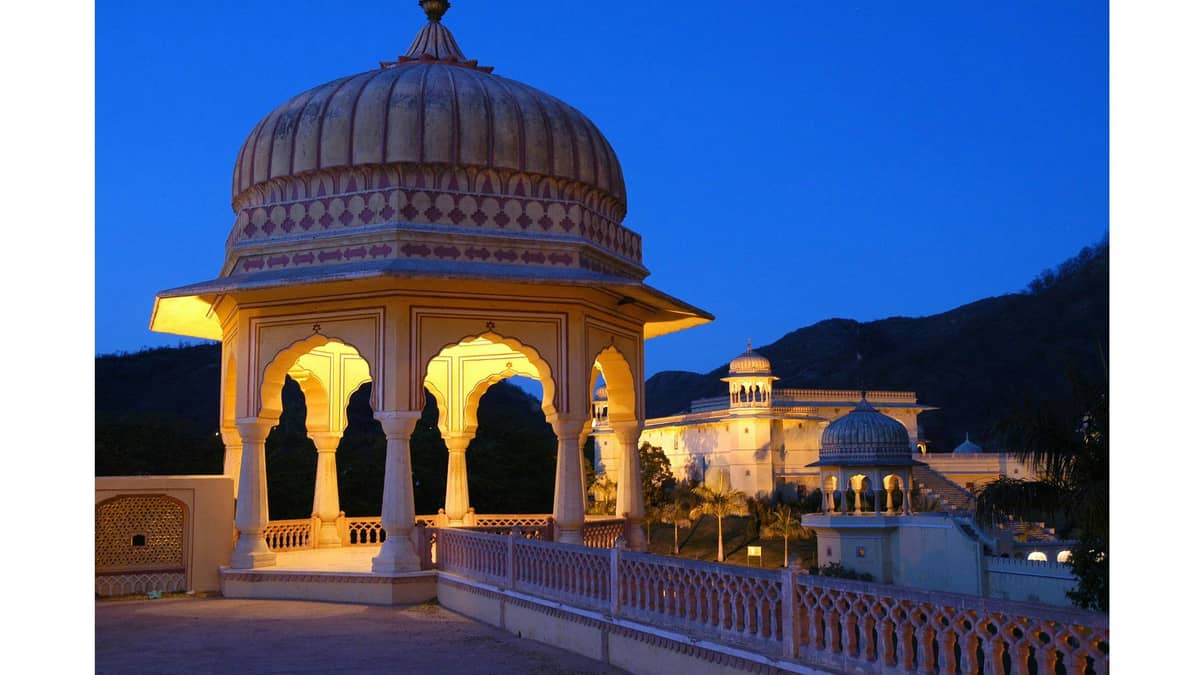
The best time to visit Jaipur depends on the season.
- Winter (Oct–March): This is the peak tourist season in Jaipur. The weather is cool and pleasant, making it ideal for sightseeing and outdoor activities. Temperatures range from 10°C to 25°C, perfect for exploring Jaipur’s forts, palaces, and vibrant markets.
- Summer (April–June): Summer in Jaipur can be scorching, with temperatures soaring above 40°C. However, this season offers fewer tourists, making it a great time for those seeking a quieter experience. Ensure to stay hydrated and take necessary precautions.
- Monsoon (July–Sept): While the monsoon season brings moderate rainfall, it adds a unique cultural richness to the city. The lush greenery surrounding Jaipur makes for a picturesque setting, and the temperatures are more bearable than in the summer months. But be mindful of occasional showers.
Overall, winter is the best time for comfortable travel, but the other seasons offer their charm.
How to Reach Jaipur
Jaipur, well-connected to major Indian cities, is easy to reach by various means of transportation.
- By Air: Jaipur International Airport (Sanganer Airport) is about 13 km from the city center and connects Jaipur to domestic and international destinations.
- By Train: Jaipur has excellent train connectivity with all major cities like Delhi, Mumbai, and Kolkata. The city’s railway station is centrally located, making it easy to travel by train.
- By Road: Jaipur is well-connected by road through NH48, making it easily accessible from Delhi, Agra, and other neighboring cities. Several buses also run between Jaipur and cities like Delhi, Ahmedabad, and Udaipur.
How to Get Around Jaipur
- Auto-rickshaws: Most practical for old city navigation; negotiate before boarding; ₹50–₹200 for most city journeys
- Ola/Uber: Available and reliable; better for longer trips to Amber Fort, Nahargarh, Chokhi Dhani
- Cycle-rickshaw: Best for old city streets (Hawa Mahal → Johari Bazaar → City Palace); ₹50–₹150
- RSRTC hop-on bus: Covers Amber Fort, City Palace, Jantar Mantar circuit; ₹300/day; convenient for independent sightseers
Tips for Visiting Jaipur
- Dress modestly when visiting temples and religious places.
- Bargaining is common in local markets like Johari Bazaar and Bapu Bazaar, so don’t hesitate to negotiate.
- Start your sightseeing early in the morning to avoid the crowds, especially at popular spots like Amber Fort and City Palace.
- Always carry sunscreen, a hat, and a water bottle, as Jaipur can get quite hot.
- Respect local customs and be mindful of local traditions when visiting cultural or historical sites.
Jaipur is a vibrant, culturally rich city with something for everyone. From majestic forts and palaces to lively bazaars and delicious food, it offers a memorable experience. To truly immerse yourself in the Pink City, consider exploring it with a local guide or a trusted travel agency. Don’t forget to bookmark this guide for your next trip to Jaipur.
From budget stays to luxury, find out what your Jaipur trip will cost.